Bloomberg reports that Intel is planning on releasing a new, higher-capacity solid state drive, which will provide users with up to 320GB of storage capacity. In Q4 this year, the company will begin selling a total of eight new drives with capacity of 320GB, that will be part of Intel's Extreme and Mainstream SSD series. The chips used for these drives will be build using 32-nanometer production technology, Intel’s most advanced manufacturing method for the time being. The source also clamins that Intel has already contacted its partners and informed them for the new drives.
The world's largest chipmaker also plans to introduce a new product called "Braidwood" that's slated for Q4 2009 too. It will include as much as 16GB of flash memory that will create “better responsiveness and boot-up time.” Though it's unclear whether this solution will be integrated into Intel based motherboards or it will stand for an optional separate storage drive, made only for installing operating systems.
Wednesday, January 21, 2009

Intel to Release Three New Quad Core LGA775 CPUs with a 65W TDP
Tuesday, January 20th 2009  The guys over at Hexus.net, have got hold of information that shows details of three new quad core processors with a thermal design power (TDP) of only 65W. The interesting thing is that it seems Intel have still not yet given up the LGA775 socket despite it being superceded. These are the lowest TDP quad cores from Intel to date, based on a 45nm manufacturing process, and in theory using up to 30W less power than current quad core processors, it shows a step in the right direction. Unfortunately it cannot be all good news, as it seems that the expected prices for these are approximatly $100 more than the similarly clocked 95W counterparts.


Intel Plans to Integrate Graphics onto New Atom CPU
Monday, January 19th 2009 According to VRZone, Intel is planning to launch the next generation of Atom CPU's in Q4 2009 with a 45nm single core version, codenamed Pineview, a dual core CPU will shortly follow in Q1 2010. It seems Intel are gearing up to a single chip solution and with this particular generation of Atom, the CPU will be joined by the IGP and memory controller and is based on Lincroft Architecture. There also appears to be a new southbridge in the works to accompany this new chip. No longer do we have ICH-XX variants, but instead this new piece of silicon has been called Tiger Point. Between the two the platform will be known as the Pine Trail-D and will support memory speeds of upto 800Mhz DDR2. Intel claims there will be a 70% reduction in total kit package size and a 50% reduction in total kit TDP.


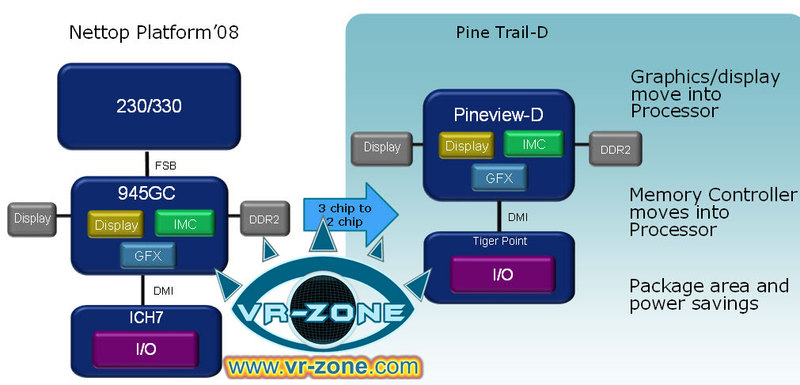

More info on Intel's "Pineview" Atom chips surfaces

According to DigiTimes, the switch to a smaller process will cut the amount of necessary mainboard space by 60 percent compared to Atom N270 CPU platforms, shrinking the overall footprint. It should also be available clocked faster than the current chips, and while onboard video processor will remain the GMA 950, clock frequency will increase from 133MHz to 200MHz. Moreover, the new southbridge will be codenamed Tigerpoint-M and will be replacing the ICH7M.
Despite these performance improvements, TDP will go down from 8W to 7W, while the average power consumption will be only 2W. The Pineview Atoms should also be cheaper to make, which could see lower netbook prices down the line, and both single core and dual core version will be available in the second half of this year – though sadly the dual-core variants will be reserved for nettops only.
Phenom II X4 In For Price-Cuts?
Barely a month into its launch, AMD's newest processors, the Phenom II X4 920 and Phenom II X4 940 Black Edition, are already in for global price-cuts, of as much as 20%, in the days to come. Sources close to the company indicate that the price-cuts are in view of the recent announcement by Intel to significantly lower the prices of certain models of its Core 2 Quad
lineup, which pose direct competition to AMD's new chips.
Once implemented, the Phenom II X4 920 would sell for US $195, down from its launch-price of $235, and a whole $50 would be waived off the $275 price-tag of the Phenom II X4 940 Black Edition, sending it down to $225. These price-cuts are not yet officially confirmed or announced by AMD, and so it isn't known as to when exactly they get officially implemented. All prices in 1000 unit tray quantities.

Once implemented, the Phenom II X4 920 would sell for US $195, down from its launch-price of $235, and a whole $50 would be waived off the $275 price-tag of the Phenom II X4 940 Black Edition, sending it down to $225. These price-cuts are not yet officially confirmed or announced by AMD, and so it isn't known as to when exactly they get officially implemented. All prices in 1000 unit tray quantities.
Monday, January 19, 2009
Monday, January 19 2009  Kingston Digital, Inc., the Flash
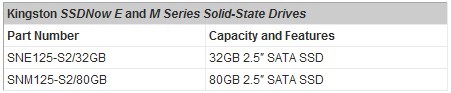
 memory affiliate of Kingston Technology Company, Inc., announced today it is shipping the first two products in its SSDNow line of solid-state drives (SSD) with the SSDNow E Series and SSDNow M Series. Kingston is targeting its SSDs to Fortune 1000 companies and select vertical markets. The SSDNow E Series is specifically designed for the enterprise server environment while the SSDNow M Series is built for the road warrior who demands ultimate performance from a notebook PC. The Kingston SSDNow E and M Series use Intel's solid-state drives, which are the best-performing drives on the market.
"We are thrilled to enter the solid-state drive market with our SSDNow E and M Series SSDs. The combination of the fastest SSDs in the world along with Kingston's tremendous distribution capabilities and legendary customer service will position us to succeed in this arena," said Mark Leathem, director of Flash business development, Kingston Digital. "The performance capabilities of these first two offerings are off the charts and our enterprise customers will be very pleased to use them in servers and corporate laptop computers."


The SSDNow E and M series drives create greater return on investment through increased performance due to impressive input and output operations per second (IOPS). The SSDNow E Series' higher IOPS means enterprises need significantly fewer SSDs compared to standard hard disk drives (HDD), which also leads to energy savings in a server environment. The SSDNow M Series high IOPS allows for faster boot times and quicker application load times which help mobile power users become even more productive.
Kingston's SSDNow uses a standard SATA hard disk drive interface but unlike an HDD, they are very rugged and can withstand shock and extreme environments as there are no moving parts. Kingston's SSDNow E and M Series drives are equipped with S.M.A.R.T (Self-Monitoring, Analysis and Reporting Technology) to monitor the integrity and reliability of the drives. The drives are backed by a three-year warranty, 24/7 tech support and KingstonCare*, a comprehensive suite of tools and services designed to reduce downtime. For more information visit kingston.com.
Kingston SSDNow M and E Series Features and Specifications:
** Some of the listed capacity is used for formatting and other functions and thus is not available for datastorage . For more information, please consult Kingston's Flash Memory Guide at Kingston.com/Flash_Memory_Guide.
*** Measurement based on IO meter


"We are thrilled to enter the solid-state drive market with our SSDNow E and M Series SSDs. The combination of the fastest SSDs in the world along with Kingston's tremendous distribution capabilities and legendary customer service will position us to succeed in this arena," said Mark Leathem, director of Flash business development, Kingston Digital. "The performance capabilities of these first two offerings are off the charts and our enterprise customers will be very pleased to use them in servers and corporate laptop computers."


The SSDNow E and M series drives create greater return on investment through increased performance due to impressive input and output operations per second (IOPS). The SSDNow E Series' higher IOPS means enterprises need significantly fewer SSDs compared to standard hard disk drives (HDD), which also leads to energy savings in a server environment. The SSDNow M Series high IOPS allows for faster boot times and quicker application load times which help mobile power users become even more productive.
Kingston's SSDNow uses a standard SATA hard disk drive interface but unlike an HDD, they are very rugged and can withstand shock and extreme environments as there are no moving parts. Kingston's SSDNow E and M Series drives are equipped with S.M.A.R.T (Self-Monitoring, Analysis and Reporting Technology) to monitor the integrity and reliability of the drives. The drives are backed by a three-year warranty, 24/7 tech support and KingstonCare*, a comprehensive suite of tools and services designed to reduce downtime. For more information visit kingston.com.
Kingston SSDNow M and E Series Features and Specifications:
- Fast: SSDNow E Series: 250MB/sec. read, 170MB/sec. write; SSDNow [M Series: 250MB/sec. read, 70MB/sec. write
- Durable: no moving mechanical parts, enabling the SSD to handle rougher conditions
- Guaranteed: backed by a three-year Kingston warranty, 24/7 tech support and KingstonCare* program
- Form factor: 2.5"
- Interface: SATA 1.5Gb/sec. and 3.0Gb/sec.
- Capacity**: SSDNow E Series: 32GB; SSDNow M Series 80GB
- Storage temperatures: -55° C to 95° C
- Operating temperatures: 0° C to 70° C
- Dimensions: SSDNow E Series: 69.85mm x 100mm x 7mm; SSDNow M
- Series: 69.85mm x 100mm x 9.5mm
- Weight: SSDNow E Series: 80 grams (+/- 2 grams); SSDNow M Series: 86 grams (+/- 2 grams)
- IOPS (Input and Output Operations Per Second): SSDNow E Series: [*Random 4K read: 35K; Random 4K write: 3.3K
- Vibration operating: 2.17 G (7-800Hz)
- Vibration non-operating: 3.13 G (10-500Hz)
- Power specs***: SSDNow E Series: Active: 2.4 W TYP; Sleep: 0.06 W TYP; SSDNow M Series: Active: 0.15 W; Sleep 0.06 W TYP
- Life expectancy: SSDNow E Series: 2 million hours mean time before failure; SSDNow M Series: 1.2 million hours mean time before failure
- Operating shock: 1,000 G/0.5 msec operating and non-operating
** Some of the listed capacity is used for formatting and other functions and thus is not available for data
*** Measurement based on IO meter
Intel 5-Series Chipset Lineup Detailed
Now faced with delays, Intel's upcoming Ibex-Peak platform, a next-generation mainstream implementation of the Nehalem architecture, is an interesting mix of technologies, where Intel seeks to minimise the platform and energy footprints while delivering value and performance through a clever bit of rearrangement of system components. HKEPC has learned that Intel's 5-Series mainstream chipsets consists of five models: P57, Q57, H57, P55, and H55. The P57 and P55 are built for the consumer PC with discrete graphics. The H57 and H55 chipsets are built for processors with integrated graphics, with support for the Intel FDI. The Q57 is built for the business / enterprise-client PC, it supports a host of exclusive Intel technologies that make the machine easier to manage.


Subscribe to:
Posts (Atom)

 Posts
Posts


