Monday, January 19, 2009

Intel Reveals New In-Store Concept Technologies at Retail's Big Show

Press Release
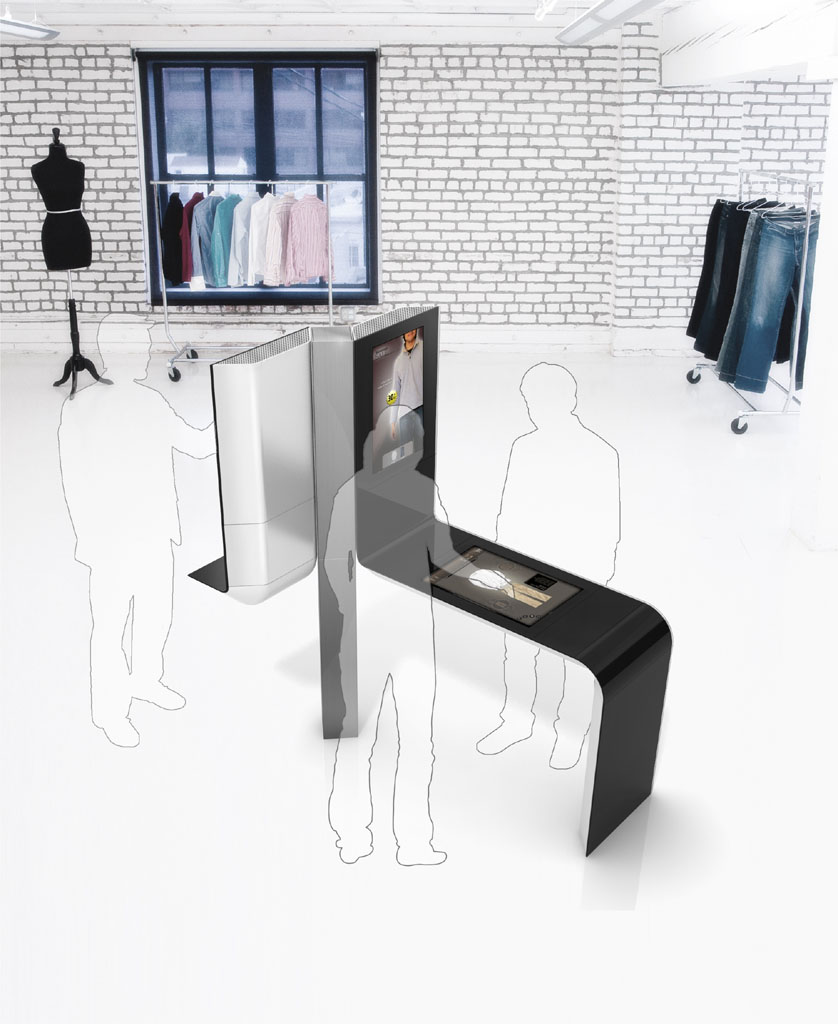
Taking advantage of a high-performing and energy-efficient chip the company already sells to computer makers, Intel Corporation today unveiled a retail point-of-sale (POS) proof-of-concept system that could lower a store's total cost of ownership while improving customer satisfaction. Revealed at the National Retail Federation Convention (NRF) in New York, Intel's proof-of-concept exhibits the latest in digital signage and point-of-sale technology in a kiosk form factor, and demonstrates how technology can enhance the retail shopping experience.


Accommodating consumer preferences for self-service fueled by e-commerce trends, the kiosk demonstration includes features that match the perks of Internet shopping, such as suggestive selling real-time inventory access, as well as showing promotions, product details and customer reviews. These features, in turn, facilitate sales associate up-selling and cross-selling opportunities, which will increase a retailer's bottom line and customer loyalty.

The POS demo is based on the very popular and energy-efficient 45nm Intel Core 2 Duo mobile processor that is inside hundreds of millions of today's laptops and PCs. Compared with legacy POS platforms, the processor in the demo can enable more than a 70 percent reduction in required power use while still providing as much as double the amount of raw processing performance as previous generations of processors.1 As such, energy savings from this POS system are passed on to retailers by way of lower energy bills.

"Intel-based technologies will ensure retailers are well-positioned to move through the current economy into a successful and profitable future, while giving their customers more information faster and easier than ever before," said Joe Jensen, general manager, Intel Embedded Computing Division. "We hope the combination of improving a customer's retail experience, while also arming sales associates with more accurate information and reducing operations costs, such as electricity bills and maintenance, is a compelling proposition for the world's retailers to take advantage of what Intel technology innovation has to offer."

The proof-of-concept platform features Intel vPro technology (Intel vPro) with Intel Active Management Technology and offers lower maintenance costs, improved power management and security options such as system diagnosis. Intel vPro technology allows administrators to manage systems remotely, making it possible to turn off all systems overnight to increase energy savings and reduce the need for technicians to go on-site for system maintenance, resulting in decreased carbon emissions and lower operational expenses for retailers.

The modular design of the proof-of-concept system promotes easy upgrades to next-generation CPU platforms so retailers can remain in sync with the latest technology advancements. The POS demo is customizable with a removable PC board and individual modules that can be added on, taken off, interchanged or replaced to meet evolving business needs.

Intel's point-of-sale proof-of-concept demo was designed by frog design, a global innovation firm based in San Francisco. The demo will be on display at the Intel booth #2717 at NRF. For more information about the demo, visit http://www.intel.com/go/ic.

ASUS and Gigabyte Overstocked with Intel 4-series Chipset Inventories

Weak market demand, a market saturated with low-cost PCs, and intra-brand competition has reportedly led to first-tier motherboard vendors such as ASUS and Gigabyte to suffer overstock of their Intel 4-series chipset motherboard inventories. The Intel 4-series chipset is the fourth generation of desktop chipsets for LGA-775 processors. It includes popular models such as P45, P43, the mainstream G45, G43 and G41, and others that include Q45, B45 and B43. Motherboards made by leading companies have had less than expected market demand. Earlier in September last year, when ASUS announced price-cuts for its 4-series motherboards, reported back then to make them "competitive", sources tell DigiTimes that the company was already facing swelling inventories.

As a result of this, the biggest loser seems to be ASUS, with a swelling inventory of 6~7 million units, valued at around $180 million, followed by Gigabyte holding an inventory worth around $130 million, which are quickly depreciating in value as the market gets closer to the launch of Intel's 5-series chipsets and the Ibex-Peak platform. With Intel planning to stick to its launch-schedule for its newest platform, motherboard vendors can only hope for Intel to reconsider its plans, delay its launch, and allow the inventories to get digested.

Intel Xeon In for Price-Cuts


Following periodic price-cuts for its Core 2 series desktop CPUs, Intel could be planning significant price-cuts for its Xeon series enterprise CPUs. This, according to Pacific Crest analyst Michael McConnell. The price-cuts are model-specific. According to McConnel, they are expected to range between 15 and 40% for quad-core Xeon processors and around 13% for dual-core models.

McConnel sees the price cuts as a response to excess inventories of Xeon processors, which is up 13% in Q4, worth up to US $3.85 billion. Another significant factor is AMD, which seems to be gaining market-share through HP, a major player with enterprise-computing. The new prices could be implemented by 18th of January.

Nvidia GeForce GTX 295 dual-GPU review @ TechSpot

Balance has now been restored with the introduction of the GeForce GTX 295, giving Nvidia a weapon to compete for the performance crown.


The Nvidia GeForce GTX 295 dual-GPU graphics card features 1792MB of memory which corresponds to the memory capacity of two GeForce GTX 260 boards. However, unlike the Radeon HD 4870 X2 which is literally two Radeon HD 4870 products stuck together, the GeForce GTX 295 seems to be more of a hybrid, sharing specs of both GeForce GTX 260 and 280 products.


Therefore, what we have here is an insanely fast graphics card that should be more than capable of taking on the Radeon HD 4870 X2. But how fast is GeForce GTX 295 exactly? We will be exploring that next.

Intuitive Convertible Design for the Intel-Powered Classmate PC Enhances Collaborative Learning

Intel® Learning Series Offers Comprehensive Solution for Global

INTERNATIONAL CONSUMER ELECTRONICS SHOW, Las Vegas, Jan. 9, 2009 – Local computer manufacturers unveiled the Intel-powered convertible classmate PC designs, joining the existing clamshell design to meet the variety of elementary school students' needs worldwide.

The new flexible design, based on Intel Corporation technologies, converts instantly from a clamshell to a tablet mode with a touch screen to allow for a more intuitive classroom experience. According to research with students and teachers, the 180-degree swivel design, rotational camera and touch screen encourage flexible classroom interaction and natural collaboration. Both the convertible and the clamshell classmate PC designs are based on ethnographic studies and feedback from pilot programs conducted in both mature and emerging markets.

Intel is also introducing the Intel® Learning Series, an initiative that integrates hardware, software and services designed specifically for education. The Intel Learning Series supports technology companies that customize products and services in their own country, innovating in and around the classmate PC reference design to enhance and improve students' experiences with technology. Working together, the technology ecosystem delivers customized products and services to meet the unique needs of education worldwide. The Intel Learning Series provides a common framework for these companies to communicate their unique roles and values in delivering the total solution to education. Local PC manufacturers will offer both the new Intel-powered convertible classmate PC and the existing clamshell design to students and teachers. The PCs will be preloaded with student-friendly software through support from the Intel Learning Series.

The addition of the new convertible PC will coexist with the very successful clamshell design, which is being used in Portugal's Magalhães (Magellan) Initiative – the Portuguese government's country-wide program to provide PCs to all elementary school children via the local computer manufacturer and telecom service providers. The Magalhães Initiative is one of most comprehensive educational technology programs in the world and other countries, like Venezuela, are working with Portugal to extend this model for their country. The Initiative reflects the scale of programs targeted for the Intel Learning Series.

Intel also unveiled its collaboration with JP Sá Couto, the local OEM in Portugal, and a local design company, CEIIA, to develop a new design of the Magalhães PC that will include features such as unique reading and writing capabilities, a larger screen, more memory for local content and additional connectivity options such as 3G and WiMAX. These new features meet the unique needs of Portugal and will be offered in addition to the existing solutions as part of the Magalhães Program.

"Education is one of the best ways to improve the future for individuals, villages, or nations," said Lila Ibrahim, general manager of the Intel Emerging Markets Platform Group, which developed the classmate PC reference design based on ethnographic research and supports the Intel Learning Series. "There are 1.3 billion school-age children around the world and of those only 5 percent have access to a PC or the Internet. The IT industry has a huge opportunity to contribute to how technology can improve students' learning and students' lives. With our announcement today, Intel continues its long-standing commitment to advancing education through technology to transform lives around the world."

Built on Intel® architecture and powered by the Intel® Atom™ processor, these purpose-built netbooks provide an affordable and functional PC to support a wide variety of classroom applications and activities. Designed with students in mind, the classmate PC is small and light enough for a child to easily carry. Equipped with a water-resistant keyboard, the classmate PC is also "backpack friendly" – able to withstand bumping in a backpack and accidental drops by students. In tablet mode, the convertible classmate PC screen has a "palm rejection" feature that is designed to allow the child to write more naturally by resting their palm on the touch screen. It also includes education-oriented software and applications from software and content vendors in the Intel Learning Series.

Microsoft removes Windows 7 Beta download limit

Microsoft has announced that it will suspend the fixed download limit for the beta version of Windows 7 following a surge in demand crashed the Microsoft website late last week. Instead, the company says that unlimited copies will be available for download until January 24, widening the beta test pool well beyond its initial 2.5 million user limit.

To get an early look at the upcoming operating system head over to the official download page. You will need a DVD burner to write the Windows 7 beta 1 ISO file to a disc, and have to meet the minimum hardware requirements, which include a 1 GHz processor, 1 GB of system memory and 16 GB of hard drive space. It goes without saying that you should avoid installing Windows 7 on your primary machine but rather use a spare system or at least dual boot using a separate partition – it’s a pretty straightforward process but here’s a guide in case you need some help.

Additionally, if you do decide to give Windows 7 a go, be sure to stay current with the release notes which are regularly updated with new notices and information. In particular, Microsoft recommends you read the MP3 files and Windows Media Center notes and install the related updates before using the Beta.

Intel to launch new CPUs for lower-cost thin notebooks

Intel is planning to release new processors for lower priced thin and light notebooks based on its Core architecture later this year. The new chips are said to be a tweak of the current ULV (ultra low voltage) Intel design and should fit into a segment pricier than the Atom, which powers netbooks, but below that of today’s ultra portable computer systems, which are typically priced at around $1500 - $3000 or even higher.

In this sense, the new chips will be comparable to the Athlon Neo processor from AMD, which was recently announced alongside a $699 ultra portable model from HP, the Pavilion dv2. Sadly, Intel doesn't seem to be quite ready to share many more details at this time, with the company only saying that the processor could be used in laptops that are less than one inch thick, and that the processor itself would measure just 22 x 22-millimeters.