Friday, January 30, 2009

Multi-Core Processors Outpacing Key Business Software


Multi-Core Processors Outpacing Key Business Software
Tools

* Print
* Email
* bookmark

The relentless doubling of cores per microprocessor chip will result in servers with far more horsepower than software can use, says Gartner

The relentless doubling of cores per microprocessor chip will drive total processor counts in upcoming generations of servers well beyond levels for which key business software has been engineered, a market research firm said Wednesday.

Technologies that will be affected by this evolution include operating systems, middleware, virtualization tools, and other applications, Gartner said. As a result, companies and other organizations will be faced with "difficult decisions, hurried migrations to new versions and performance challenges."

"Looking at the specifications for these software products, it is clear that many will be challenged to support the hardware configurations possible today and those that will be accelerating in the future," Gartner analyst Carl Claunch said in a statement. "The impact is akin to putting a Ferrari engine in a go-cart; the power may be there, but design mismatches severely limit the ability to exploit it."

Monday, January 26, 2009

Intel Readies R0 Revision of Core 2 Quad Q8200


TC Magazine reports that Intel is preparing a little upgrade on its modest 2.33GHz 45nm Core 2 Quad Q8200 processors. The Q8200 CPUs will pass from M1 to R0 stepping next month. The revised R0 processors will begin to be supplied from February 23rd through April 20, 2009. As reported Q8200 R0 will feature a halide free package, new S-spec and MM numbers, a CPUID changed from 10677 to 1067A, and Power State Indicator (PSI) support with Intel 4 series chipsets. To decrease energy consumption and update monitoring functions, the R0 quad-core processors will bring in three new low power states (Extended Stop Grant State, Deep Sleep State and Deeper Sleep State) and new XSAVE/XRSTOR instructions. A BIOS update for your motherboard will likely be needed if you happen to own a R0 quad-core.

Intel Planning Low-Power Lynnfield Processors


Earlier this month, Intel released a series of its Core 2 Quad processors with low power ratings, rated TDPs at 65W. This move served two purposes: to bring down the energy footprints of the CPUs, and to propagate quad-core chips to even those platforms whose electrical components are built for CPUs in that 65W power range. An example of that would be small form-factor PCs, mini-ITX motherboards with LGA-775 sockets, and some variants that might make it to notebooks. Intel now has plans to bring in a low-power Lynnfield processor sometime in Q1 2010. Given the amount of machinery the Lynnfield processors hold: four x86 processing cores, a dual-channel IMC, internal QPI and PCI-Express root complexes, in some cases even an IGP, a low-power variant sounds like a great engineering feat. We don't exactly know as to what low-power in context of Lynnfield is, at this point, but we can tell it will bring down platform power consumptions, given that the processor could end up being the single largest power consumer on a motherboard, and its power consumption affects that of the entire platform significantly.

Intel to Call on AMD, to Discuss Possible License Violations

Silicon giant Intel flexed its IPR muscle by reportedly calling rival AMD to discussions on possible violations of past license agreements. AMD and Intel share license agreements dating back to 1976, which eventually transformed into the agreement of letting AMD use Intel's x86 micro-architecture in making its own products. Later in 2001, the two companies met again to share x86-related technologies. Such agreements bind licensees of the x86 architecture to confining their technologies to themselves as the license is non-transferable.

The two companies are expected to meet to discuss on how the past two major events in the recent history of AMD: the acquisition of ATI Technologies, and the spin-off of the manufacturing division to The Foundry Company respect the terms of the agreements. Earlier, AMD stated that the ATI acquisition does not violate any of its cross-agreements with Intel, while the company sounds optimistic about getting The Foundry Company to existence smoothly through one of its big hurdles: a clean-chit from Intel, after having crossed bigger hurdles such as government approvals and support from the various countries it holds its facilities in.

Nvidia releases Forceware 181.22 WHQL drivers

Nvidia has released a new set of WHQL-certified drivers to provide GeForce owners with support for some of the latest gaming applications and add a couple of new features. The new package, version 181.22, contains the latest PhysX System Software (9.09.0010) and features improved support for GPU accelerated physics effects in the highly anticipated Mirror’s Edge title by Electronic Arts.


Of course, just like with older drivers, PhysX requires a GeForce 8-series card or later sporting at least 256MB of dedicated video memory. Aside from this, a few bug fixes are also included, which can be found in the release notes available here in PDF form. The new driver supports Nvidia’s GeForce 6, 7, 8 and 9-series GPUs as well as the newer GTX 200-series, and can be downloaded for Windows Vista (32 or 64-bit) and Windows XP (32 or 64-bit).

Intel to cut up to 6,000 workers, close 2 plants

Intel is yet another big-name company with large job cuts in the near future, following the announcement that they plan to shut down some of their manufacturing plants and slimming production at others. Two overseas plants, located in Malaysia and the Philippines, will be shut down in the coming months, both of which produced older-technology silicon. In addition to the plants closing, the company will also be halting production of older 200mm technology at their famous Fab 20 in Oregon, which is one of their largest.

The plants closing and production halts will result in large job cuts, upwards of 7% of their workforce. That represents 5,000 to 6,000 people, though luckily for them some positions will be made open at other Intel facilities. All of this is an effort by Intel to reduce their overhead in producing older technology, allowing them to focus on newer development.

Wednesday, January 21, 2009

More Details Trickle in on Intel's New Atom Platform, the Pine Trial-D Based Nettop

Wednesday, January 21st 2009

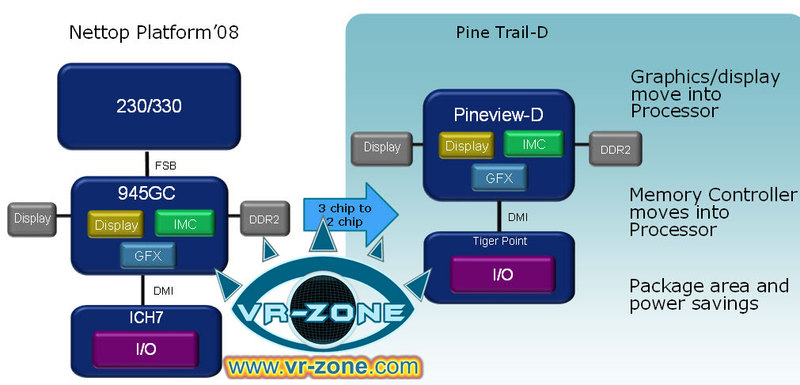
Following the story which we covered just a few days ago, Expreview has got more information on the new Intel Atom platform, codenamed Pine Trail-D. From the new information, we see that the CPU, IGP and MCH will in fact all be integrated into one chip, as opposed to just being moved onto the same die. The CPU has also been listed as at least 1.6Ghz, double that of the current entry level Atom processor. Despite the platform having no need for a northbridge, with it all moved into the CPU, Intel have managed to keep the die size at 484 sq. mm. On that note however, it seems that the IGP is still DirectX 9 based, though further details on the graphical capabilities are still not yet known. We also see, that the new Tigerpoint southbridge, will support 8 USB devices, 4 PCI-E x1 lanes, 2 PCI ports, 2 SATA ports and HD audio.

Intel Plans to Release 320GB Solid-state Drives in Q4 2009


Bloomberg reports that Intel is planning on releasing a new, higher-capacity solid state drive, which will provide users with up to 320GB of storage capacity. In Q4 this year, the company will begin selling a total of eight new drives with capacity of 320GB, that will be part of Intel's Extreme and Mainstream SSD series. The chips used for these drives will be build using 32-nanometer production technology, Intel’s most advanced manufacturing method for the time being. The source also clamins that Intel has already contacted its partners and informed them for the new drives.
The world's largest chipmaker also plans to introduce a new product called "Braidwood" that's slated for Q4 2009 too. It will include as much as 16GB of flash memory that will create “better responsiveness and boot-up time.” Though it's unclear whether this solution will be integrated into Intel based motherboards or it will stand for an optional separate storage drive, made only for installing operating systems.

Intel to Release Three New Quad Core LGA775 CPUs with a 65W TDP

Tuesday, January 20th 2009
The guys over at Hexus.net, have got hold of information that shows details of three new quad core processors with a thermal design power (TDP) of only 65W. The interesting thing is that it seems Intel have still not yet given up the LGA775 socket despite it being superceded. These are the lowest TDP quad cores from Intel to date, based on a 45nm manufacturing process, and in theory using up to 30W less power than current quad core processors, it shows a step in the right direction. Unfortunately it cannot be all good news, as it seems that the expected prices for these are approximatly $100 more than the similarly clocked 95W counterparts.

Intel Plans to Integrate Graphics onto New Atom CPU

Monday, January 19th 2009

According to VRZone, Intel is planning to launch the next generation of Atom CPU's in Q4 2009 with a 45nm single core version, codenamed Pineview, a dual core CPU will shortly follow in Q1 2010. It seems Intel are gearing up to a single chip solution and with this particular generation of Atom, the CPU will be joined by the IGP and memory controller and is based on Lincroft Architecture. There also appears to be a new southbridge in the works to accompany this new chip. No longer do we have ICH-XX variants, but instead this new piece of silicon has been called Tiger Point. Between the two the platform will be known as the Pine Trail-D and will support memory speeds of upto 800Mhz DDR2. Intel claims there will be a 70% reduction in total kit package size and a 50% reduction in total kit TDP.

More info on Intel's "Pineview" Atom chips surfaces

We already reported on the fact that updated Intel Atom chips are expected to arrive sometime by mid-2009, with just a slightly speedier core frequency of 1.66GHz, but also with new HD-capable graphics via the GN40 chipset and memory support boosted from DDR2 533 to DDR2 667. Additionally however the company is planning to launch its 45nm successor, codenamed Pineview, with an on-chip memory controller and integrated graphics processor.

According to DigiTimes, the switch to a smaller process will cut the amount of necessary mainboard space by 60 percent compared to Atom N270 CPU platforms, shrinking the overall footprint. It should also be available clocked faster than the current chips, and while onboard video processor will remain the GMA 950, clock frequency will increase from 133MHz to 200MHz. Moreover, the new southbridge will be codenamed Tigerpoint-M and will be replacing the ICH7M.

Despite these performance improvements, TDP will go down from 8W to 7W, while the average power consumption will be only 2W. The Pineview Atoms should also be cheaper to make, which could see lower netbook prices down the line, and both single core and dual core version will be available in the second half of this year – though sadly the dual-core variants will be reserved for nettops only.

Phenom II X4 In For Price-Cuts?


Barely a month into its launch, AMD's newest processors, the Phenom II X4 920 and Phenom II X4 940 Black Edition, are already in for global price-cuts, of as much as 20%, in the days to come. Sources close to the company indicate that the price-cuts are in view of the recent announcement by Intel to significantly lower the prices of certain models of its Core 2 Quad lineup, which pose direct competition to AMD's new chips.

Once implemented, the Phenom II X4 920 would sell for US $195, down from its launch-price of $235, and a whole $50 would be waived off the $275 price-tag of the Phenom II X4 940 Black Edition, sending it down to $225. These price-cuts are not yet officially confirmed or announced by AMD, and so it isn't known as to when exactly they get officially implemented. All prices in 1000 unit tray quantities.

Monday, January 19, 2009

Monday, January 19 2009
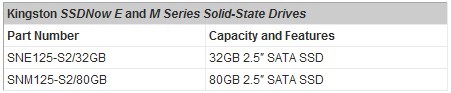
Kingston Digital, Inc., the Flash memory affiliate of Kingston Technology Company, Inc., announced today it is shipping the first two products in its SSDNow line of solid-state drives (SSD) with the SSDNow E Series and SSDNow M Series. Kingston is targeting its SSDs to Fortune 1000 companies and select vertical markets. The SSDNow E Series is specifically designed for the enterprise server environment while the SSDNow M Series is built for the road warrior who demands ultimate performance from a notebook PC. The Kingston SSDNow E and M Series use Intel's solid-state drives, which are the best-performing drives on the market.

"We are thrilled to enter the solid-state drive market with our SSDNow E and M Series SSDs. The combination of the fastest SSDs in the world along with Kingston's tremendous distribution capabilities and legendary customer service will position us to succeed in this arena," said Mark Leathem, director of Flash business development, Kingston Digital. "The performance capabilities of these first two offerings are off the charts and our enterprise customers will be very pleased to use them in servers and corporate laptop computers."


The SSDNow E and M series drives create greater return on investment through increased performance due to impressive input and output operations per second (IOPS). The SSDNow E Series' higher IOPS means enterprises need significantly fewer SSDs compared to standard hard disk drives (HDD), which also leads to energy savings in a server environment. The SSDNow M Series high IOPS allows for faster boot times and quicker application load times which help mobile power users become even more productive.

Kingston's SSDNow uses a standard SATA hard disk drive interface but unlike an HDD, they are very rugged and can withstand shock and extreme environments as there are no moving parts. Kingston's SSDNow E and M Series drives are equipped with S.M.A.R.T (Self-Monitoring, Analysis and Reporting Technology) to monitor the integrity and reliability of the drives. The drives are backed by a three-year warranty, 24/7 tech support and KingstonCare*, a comprehensive suite of tools and services designed to reduce downtime. For more information visit kingston.com.

Kingston SSDNow M and E Series Features and Specifications:
  • Fast: SSDNow E Series: 250MB/sec. read, 170MB/sec. write; SSDNow [M Series: 250MB/sec. read, 70MB/sec. write
  • Durable: no moving mechanical parts, enabling the SSD to handle rougher conditions
  • Guaranteed: backed by a three-year Kingston warranty, 24/7 tech support and KingstonCare* program
  • Form factor: 2.5"
  • Interface: SATA 1.5Gb/sec. and 3.0Gb/sec.
  • Capacity**: SSDNow E Series: 32GB; SSDNow M Series 80GB
  • Storage temperatures: -55° C to 95° C
  • Operating temperatures: 0° C to 70° C
  • Dimensions: SSDNow E Series: 69.85mm x 100mm x 7mm; SSDNow M
  • Series: 69.85mm x 100mm x 9.5mm
  • Weight: SSDNow E Series: 80 grams (+/- 2 grams); SSDNow M Series: 86 grams (+/- 2 grams)
  • IOPS (Input and Output Operations Per Second): SSDNow E Series: [*Random 4K read: 35K; Random 4K write: 3.3K
  • Vibration operating: 2.17 G (7-800Hz)
  • Vibration non-operating: 3.13 G (10-500Hz)
  • Power specs***: SSDNow E Series: Active: 2.4 W TYP; Sleep: 0.06 W TYP; SSDNow M Series: Active: 0.15 W; Sleep 0.06 W TYP
  • Life expectancy: SSDNow E Series: 2 million hours mean time before failure; SSDNow M Series: 1.2 million hours mean time before failure
  • Operating shock: 1,000 G/0.5 msec operating and non-operating
* SSDNow E Series only. See your sales representative to determine your eligibility for KingstonCare.
** Some of the listed capacity is used for formatting and other functions and thus is not available for data storage. For more information, please consult Kingston's Flash Memory Guide at Kingston.com/Flash_Memory_Guide.
*** Measurement based on IO meter


Intel 5-Series Chipset Lineup Detailed

Sunday, January 18th 2009

Now faced with delays, Intel's upcoming Ibex-Peak platform, a next-generation mainstream implementation of the Nehalem architecture, is an interesting mix of technologies, where Intel seeks to minimise the platform and energy footprints while delivering value and performance through a clever bit of rearrangement of system components. HKEPC has learned that Intel's 5-Series mainstream chipsets consists of five models: P57, Q57, H57, P55, and H55. The P57 and P55 are built for the consumer PC with discrete graphics. The H57 and H55 chipsets are built for processors with integrated graphics, with support for the Intel FDI. The Q57 is built for the business / enterprise-client PC, it supports a host of exclusive Intel technologies that make the machine easier to manage.

Intel Postpones the Launch Schedule of Lynnfield CPUs and P55 Chipset


I'm afraid that what's to be told here, is hard to be categorized as good news. Industry observer DigiTimes reports that Intel is about to postpone the initiation of Lynnfield processors and P55 chipset. Chips based on the quad-core Lynnfield design, are supposed to bring Nehalem to more people, because they'll represent the budget line of Core i7 processors.

Intel has recently decided to postpone its next-generation mainstream CPU Lynnfield along with the P55 chipset to the end of August or the beginning of September this year, and may postpone them to an even later time depending on the market situation, according to sources at motherboard makers. Both Lynnfield and P55 were originally scheduled to launch by the end of July. The economic decline which has caused motherboard makers to suffer overstocked chipset inventory is the major reason for the pull back, according to the sources. After the P55 launches, Intel plans to phase out non-IGP P45 and P43 chipsets and will transition its 4-series IGP chipsets to the entry-level.

Intel January Price Cuts Update


On Monday we informed you here that Intel intends to cut the prices on some of its processors. Well, it looks that HKEPC's information wasn't exactly precise as some of our readers pointed out. Now thanks to The Tech Report we have some new info, the new prices will hit on Monday, January 19 and primarily affect Intel's 45nm quad-core processors:
  • Core 2 Quad Q9650 3.00GHz 12MB 1333MHz $530 -> ~$322
  • Core 2 Quad Q9550 2.83GHz 12MB 1333MHz $316 -> ~$267
  • Core 2 Quad Q9400 2.66GHz 6MB 1333MHz $266 -> ~$217
  • Core 2 Quad Q8300 2.50GHz 4MB 1333MHz $224 -> ~$194
  • Core 2 Quad Q8200 2.33GHz 4MB 1333MHz $193 -> ~$163
Again, this is information from "an anonymous tipster", so these prices may vary.

Intel and AMD Postpone 100% DDR3 Transition

Leading CPU makers Intel and AMD have adopted memory standards in fairly quick succession in the past. This however, doesn't seem to be the case with DDR3. AMD is yet to release a CPU that supports DDR3 memory, and is two years behind Intel with its DDR3 implementation plans. Intel on the other hand has managed 100% DDR3 dependency with only its premium Core i7 platform, with DDR3 not completely replacing DDR2 in any of its mainstream or value lineups.

Market factors, namely the DRAM manufacturing industry, are increasingly posing difficulties to CPU makers to bring DDR3 memory at a consumer-friendly price point. With manufacturing costs refusing to come down and the Core i7 not able generate the expected demand that justifies selling triple channel kits at sub-$100 price-points, CPU makers are rethinking their large-scale DDR3 standard transition plans for their entire lineups. Intel on its part is contemplating on postponing its 5-series mainstream platform for the Intel Core i5 series processors. AMD on the other hand, is still struggling with technical difficulties in achieving stability and compatibility with DDR3 memory on its DDR3-supportive memory controllers the upcoming AM3-socket CPUs come with. So the company is also unlikely to transition to DDR3 until it is able to come out with a workable BIOS, sources add. It could be as long as 2010 by when a 100% industry-wide implementation of DDR3 can take place.

Intel to delay mainstream Core i7 processors?

Intel could push back the launch of its mainstream Core i7 desktop processors, codenamed Lynnfield, along with its P55 chipset by at least a month. This according to DigiTimes, which claims the poor economic conditions have created significant overstock problems that will require motherboard makers to continue selling their current P4x-based hardware for a bit longer.

The two products were initially scheduled to be launched by the end of July this year, but apparently won't arrive until late August or early September, perhaps even at a later time depending on the market situation. Considering that Intel just announced its Q4 2008 profits were down 90 percent from the same quarter in 2007, one can only assume the chipmaker itself has plenty of unsold inventory, and is in no condition to argue with its motherboard partners.

In fact, rumor has it that these same overstock problems will force Intel to announce a price cut on Monday, affecting its line of Core 2 Quad processors. Meanwhile, it is also being reported that Intel has been forced to put off their transition to DDR3-only products until 2010 over pricing concerns, and they will be joined by AMD which has also delayed adoption due to technical difficulties.

Intel Atom N280 Details Surface


Back in June 2008, when Intel Introduced the Atom N270, reviewers found its level of performance sufficient for ULPC applications back then. Over a period of six months, it became evident that ULPCs require to deliver a little more than just internet applications. With Intel being reluctant on porting the dual-core Atom to ULPC, owing to its thermal characteristics, there is a need for stepping up the performance level of its relatively cooler single-core Atom.

Therefore, Atom N280. Earlier speculations pointed out that this chip would merely come with a multiplier boost sending its clock speed to 1.86 GHz against 1.60 GHz of its predecessor, but it turns out that Intel was looking to expand the FSB of the existing N270, with a minor clock speed increase. The Atom N280 features a broader 667 MHz FSB against the 533 MHz the N270 comes with. It ends up with a clock speed of 1.66 GHz. While N270 achieved its 1.60 GHz with (12 x 133 MHz), N280 does it with (10 x 166 MHz). Hypothetically, a future model with a 12x FSB multiplier could set the clock speed at 2.00 GHz. What's more, Intel gets rid of the i945GSE chipset infamous for thermal characteristics increasingly unsuitable for ULPCs. It has been replaced with the supposedly cooler GN40 chipset. The N280 has begun surfacing on specification sheets of upcoming ASUS Eee PC models, but it will be only by 2Q, 2009 by the time we start seeing products based on it. Paired with the GN40, the Atom N280 is expected to be priced at US $60-65.

Cisco, Intel and Microsoft Lead Collaboration to Improve Global Education Assessments

Press Release
Three leading technology companies announced today a collaboration aimed at transforming global educational assessment and improving learning outcomes. At the Learning and Technology World Forum in London, Cisco, Intel and Microsoft unveiled plans to underwrite a multi-sector research project to develop new assessment approaches, methods and technologies for measuring the success of 21st-century teaching and learning in classrooms around the world. During the session, the three companies called upon educational leaders, governments and other corporations to join in the effort.

The three companies also announced the appointment of Barry McGaw PhD, currently the director of the Melbourne Education Research Institute at the University of Melbourne, as executive director of the project. McGaw will oversee an executive committee, project lead team, and up to 50 leading experts and innovators in academia and government, to collaborate on the research and assist in influencing the development of future international and national assessments.

With an extensive background in academia and research, McGaw has served as the director for Education at the Organization for Economic Co-Operation and Development (OECD) where he was involved with international education assessments in the Program for International Student Assessment (PISA).

"Shrinking resources and market pressures mean that education can no longer be the sole responsibility of governments," said McGaw. "Building the future workforce will require a commitment from the private sector to partner with public institutions. Reforming assessment is essential to enabling any systemic change in education. And change on a global scale is required to equip students of today with the skills they need to succeed in the workforce of tomorrow. PISA's international education assessments focus on key competencies in reading, mathematics and science. In PISA 2003, we took a step by adding an assessment of problem solving, but one limited to analogical reasoning. We hoped to add information and communications technology (ICT) competence in PISA 2006 but did not succeed. We all need now to work together to advance assessment practice."

The assessment research and development project spearheaded by Cisco, Intel and Microsoft has received the support of major international assessment organizations. Specifically, OECD and the International Association of the Evaluation of Educational Achievement (IEA) have expressed interest in using the evidence-based and verifiable output of the 21st-century skills assessment to inform the development of the next versions of PISA and Trends in International Mathematics and Science Study (TIMSS), their respective international benchmarks.

"In the global economy, it is the world's best performing education systems, not simply improvement by national standards, that have become the yardstick for educational success," said Andreas Schleicher, Head of Education Indicators and Analysis, OECD. "That is why more and more countries measure the relative strengths and weaknesses of their education systems with OECD's global PISA assessments. To do so effectively, it is crucially important that these assessments continue to evolve to reflect the skills that matter for individuals and economies. Technology-based assessments will be critical to this and the project brings together key partners that can help PISA make this happen".

"IEA is committed to the greater integration of IT into all its assessments, especially TIMSS and the Progress in International Reading Literacy Study," said Seamus Hegarty, chair of the IEA. "This reflects the changes in learning environments and the potential of technology to enhance the teaching and learning process. We look forward to working with the collaboration to achieve our common goals for young learners."

Based on extensive research1, Cisco, Intel and Microsoft concluded that most education systems have not kept pace with the dramatic changes in the economy and the skill sets that are required for students to succeed. These skills include the ability to think critically and creatively; to work cooperatively; and to adapt to the evolving use of technology in business and society.

The project will focus on several key areas that will offer the most promising opportunities for transforming education and assessment. Teams of educators and academics will focus on enabling education assessment methodologies and technologies, effective learning environments, and replicable ICT-enabled teaching and assessment methods that foster the development and assessment of the skills students will need to succeed. To accelerate the project in time to influence the next versions of PISA and TIMSS, the project will review successful classroom practices for the teaching and testing of 21st-century skills and draw implications for large-scale assessments.

"Cisco believes a holistic transformation of the global educational system requires a long-term, multi-stakeholder commitment from the public and private sector," said Michael Stevenson, vice president of Global Education, Cisco. "We believe the collaboration between Cisco, Intel and Microsoft can serve as an impetus in creating and implementing an international assessment standard to measure skills and abilities that are critical for student success in the 21st-century."

"Cisco, Intel and Microsoft each have a long commitment to global education and enabling and empowering educators," said Will Swope, Intel's vice president and general manager, Corporate Sustainability Group. "The collaboration will help us to reach our common goal of transforming education around the world. Specifically, we are aiming to resolve the gap that exists between what goes on in schools and what goes on in the real world and better measure the skills that are truly needed for the 21st-century."

"As we continue to engage with government leaders, institutions and educators, one of the most important points that is consistently raised is the need for public and private sectors to unite in an effort to extend access to quality education, increase graduation rates and create a consistent way to measure success," said Anoop Gupta, corporate vice president for the Unlimited Potential Group, the Education Product Group, and Technology Policy and Strategy at Microsoft. "Through this collaboration, we hope to inspire others to join the mission because we believe that, together, we can make greater impact towards ensuring students of today are better prepared for the workforce of tomorrow."